 |
| Site Admin |
 |
Joined: Sun Jul 26, 2009 2:18 pm
Posts: 64479
|
Extended Coverage from the IndyStar. . 
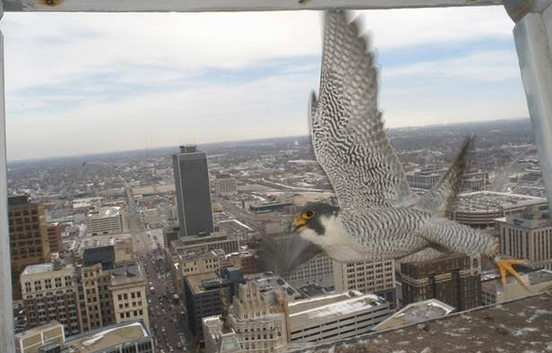
Kinney, the 19-year-old Peregrine Falcon that gained fame patrolling the buttresses of Downtown Indianapolis, was found dead outside the 29th floor of Market Tower on Friday, apparently from colliding with the building.
From their nesting box on Market Tower’s 31st floor, Kinney and his family have been fixtures in the daily life of the city’s Monument Circle and featured on The Indianapolis Star’s Falcon Cam since the cameras were installed in 2001, being one of the most popular pages on IndyStar.com.
Laura James-Reim, a volunteer who has kept a blog monitoring falcons for The Indianapolis Star for the past several years, said we may never know what exactly caused Kinney to collide with the building, but she said the raptor “beat the odds” and that 19 is an advanced age for a species that rarely lives longer than seven years.
Officials will meet next week to determine if his remains can be used as an educational taxidermy mount.
Kinney served as the patriarch for one of the largest families of falcons in the country. He is survived by his mate, KathyQ, and 61 offspring and countless grandchildren.
Kinney entered the record books as the most fecund male falcon in the Midwest. Tracking the offspring is difficult, however, and as few as 20 percent of falcons survive their first year.
The use of pesticides caused falcon shells to thin, killing chicks before they hatched and plunging the national number of falcons to dangerously levels in the 1970s.
Kinney was part of the large-scale rehabilitation that followed. Hatched in Montana by an independent falcon breeder in 1993, Kinney was brought to bolster the local Kentucky population.
Except Kinney didn’t stick around for long. Bird watchers first noticed him in Indianapolis in 1994 and he began nesting in 1995. KathyQ, named for a former Department of Natural Resources employee, Kathy Quimbach, ousted Kinney’s first mate, Scout, in 2001.
Those who knew Kinney roundly called him an attentive father and a family man, citing his taste for playing aerial tag with his children. Phyllis Zimmerman, another volunteer, said Kinney once directed monitors to the alley where a son had died.
Being a male peregrine falcon, Kinney was smaller than both of his mates, and deferred to them frequently.
“We used to hear what almost sounded like haranguing,” Zimmerman said, “It sort of sounded like KathyQ was saying, ‘What’s the matter with you? Go out and get us some food!’”
Zimmerman said it was Kinney’s attentive fathering that made her decide to devote her free time to monitoring the falcons during mating season for the past 16 years.
“You sort of got hooked by the whole thing, the drama,” she said, “You sort of felt like a babysitter, like it was your duty to watch them.
She recalled a rainy day when a female juvenile Kinney had had with his previous mate, Scout, was first gaining the courage to fly. She had holed up on an eagle statue near the top of the Soldiers’ and Sailors’ Monument for day before trying to fly back across the circle to the nest.
When the daughter finally tried, Zimmerman said she was going well, “must have gotten nervous” about halfway and started flailing in the air. Then, Zimmerman remembered seeing Kinney and Scout swoop from above, coming along the juvenile on both sides. The juvenile corrected.
“They didn’t quite touch the tips of their wings,” Zimmerman said, “but both parents were there, encouraging her, making sure she was OK.”
Together, Kinney and his mate escorted their daughter home.
|
|

 Login
Login Register
 FAQ
FAQ


 I guess the only thing of comfort I can say is that he apparently died quickly and didn't suffer.









 "
"